| Car Gears |
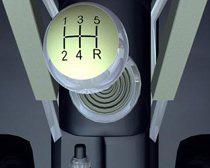
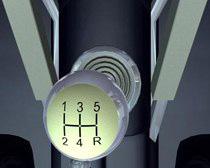
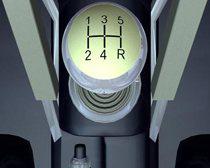
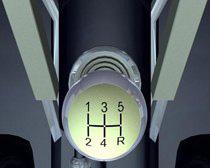
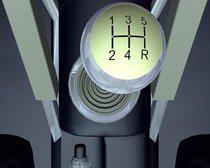
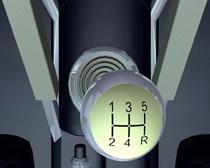
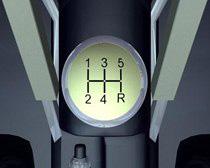
To change gear in a car: Release the accelerator pedal and at the same time press the clutch pedal down. Remove your left hand from the steering wheel, cup it around the gear knob and move the lever gently but positively from one position to another. Return your left hand to the steering wheel. Release the clutch pedal and simultaneously apply power by pressing down on the accelerator pedal. Remember: The low gears provide lots of acceleration but run out of steam before the vehicle is moving very quickly. The high gears provide the speed but not the acceleration. For a smooth ride you should avoid "snatching" (changing gear with too much force). To make the gear change smoother, let the gearshift pause for a second as it crosses the neutral zone. |

FIRST
- The gear giving the greatest power but lowest speed. Used for moving
off, manoeuvres and negotiating hazards. |

SECOND
- Used for slow speed situations such as roundabouts and junctions,
for moving off downhill and for increasing speed after moving off. |

| THIRD
- Used for driving uphill, through a hazard at speed and where a greater
degree of power is needed than fourth will allow. |

FOURTH
- Low power but the greatest speed range. Used for most driving situations
at and over 30 mph where there are no hazard to negotiate. |

FIFTH
- Lowest power, highest speed. Used for high speed cruising on dual
carriageways, motorways and other such open roads. |

REVERSE
- A high powered gear used for driving the vehicle backwards. |

| NEUTRAL - Disengages the engine from the wheels. |
On your test, when changing gears, the examiner will expect you to:Use
the controls smoothly and correctly |
| Home/Practical | Video Tutorials | Theory Test | Hazard Test | Show Me Tell Me | Theory Centres | Practical Centres |
| Centre PassRates | Your First Car | Car Insurance | Car Finance | Driving Shop | Driving Schools | Sitemap |